


20 Apr The Human + AI Balance: What Should (and Shouldn’t) Be Automated
Artificial intelligence is changing how marketing teams operate. Campaigns move faster, content production scales more easily, and creative workflows have become far more efficient than they were only a few years ago. Across the real estate industry, companies are automating tasks that once required significant manual effort, and many of those changes are improving marketing performance in meaningful ways.
But there is also a growing temptation to automate too much.
As AI tools become more advanced, some companies are starting to treat automation as a replacement for creative thinking instead of a support system for it. That usually creates marketing that feels efficient but forgettable. The content becomes repetitive, the branding loses personality, and the emotional connection behind the campaign starts to disappear.
That is a dangerous direction for luxury real estate marketing.
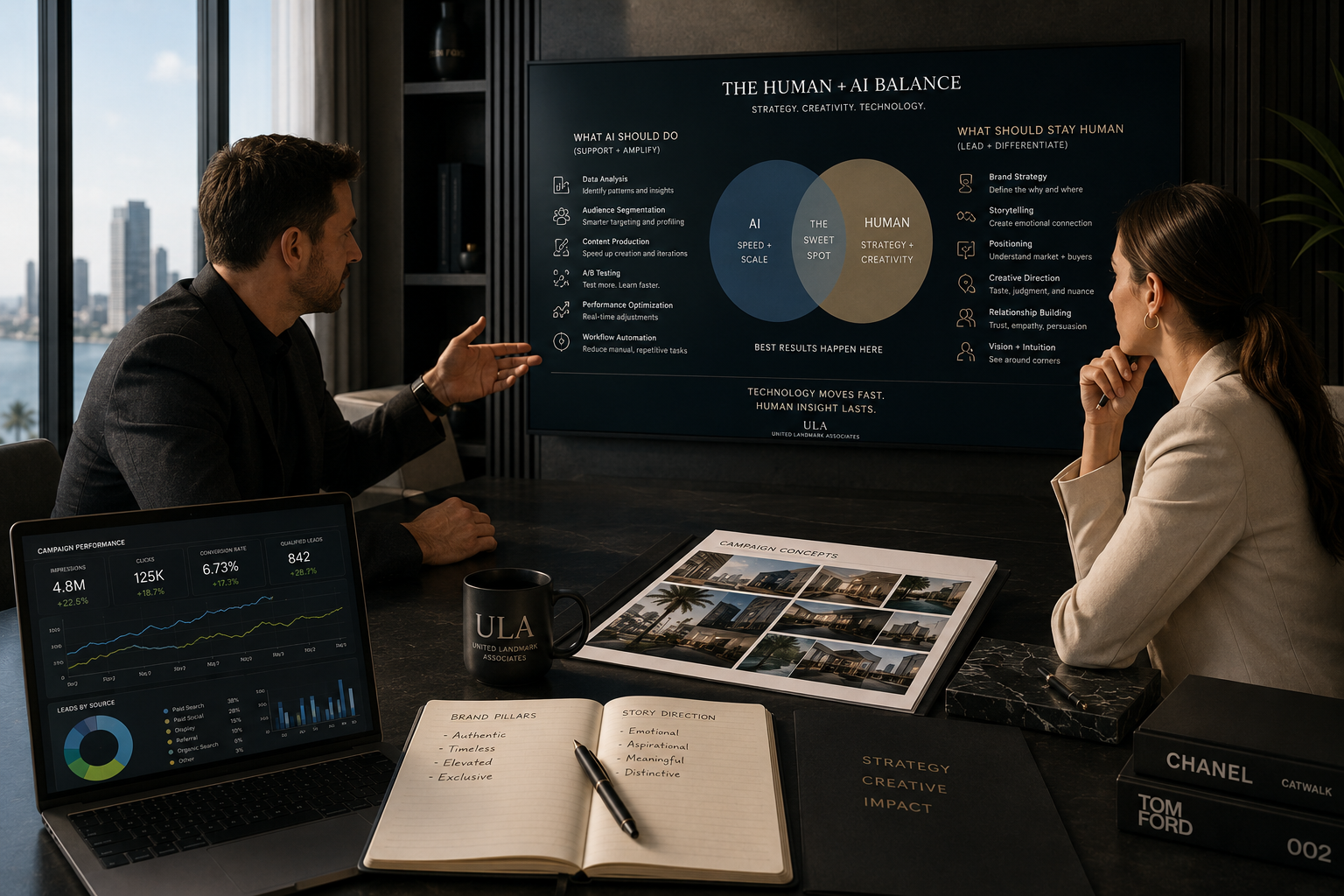
At United Landmark Associates, we believe the strongest marketing comes from balancing technology with human insight. AI improves speed, testing, production, and optimization. But the core elements that shape a luxury brand still depend on people who understand storytelling, positioning, buyer psychology, and long-term brand perception.
Some Parts of Marketing Should Absolutely Be Automated
AI already performs extremely well in certain areas of marketing. Tasks involving large amounts of data, repetitive production work, and continuous optimization are exactly where automation creates value.
Modern AI systems can help marketing teams:
- analyze campaign performance faster
- test creative variations more efficiently
- optimize ad delivery in real time
- identify audience behavior trends
- scale content production
- improve operational workflows
Those capabilities matter because modern marketing moves quickly. Digital campaigns generate enormous amounts of performance data across search, social, email, websites, CRM systems, and advertising platforms. AI helps teams process that information faster and respond earlier when campaigns need adjustments.
That speed improves efficiency without necessarily affecting creative quality.
According to McKinsey & Company, organizations using AI in marketing and sales continue reporting some of the strongest operational gains across business functions. The biggest improvements often come from automation handling repetitive tasks while teams focus more attention on higher-level decision-making.
That balance is where AI becomes most valuable.
Brand Voice Still Depends on Human Judgment
Luxury branding is emotional by nature. Buyers are not simply evaluating floor plans, amenities, or square footage. They are responding to identity, aspiration, exclusivity, and how a development makes them feel. That emotional layer is difficult to automate because it depends heavily on nuance and human interpretation.
AI does not naturally understand brand voice the way experienced creative teams do.
It can imitate tone patterns. It can rewrite messaging and generate endless variations. But it does not fully understand the subtle differences between sophisticated branding and generic luxury language. Without oversight, AI-generated copy often drifts toward repetitive phrasing and interchangeable messaging that weakens brand distinction over time.
That problem is becoming increasingly visible across real estate marketing.
Different developments are starting to sound identical online because too much of the content is being generated without enough strategic direction or editorial refinement. The language becomes polished but emotionally flat. Buyers may not consciously recognize why the branding feels generic, but they notice the lack of personality quickly.
Strong brand voice still requires human involvement.
Storytelling and Positioning Cannot Be Fully Automated
Positioning is one of the most important parts of luxury real estate marketing, and it remains heavily dependent on human insight.
A branded waterfront residence in Florida requires a completely different emotional strategy than a mountain retreat in Colorado or an urban tower targeting international investors. The buyer motivations are different. The pacing of the messaging changes. The lifestyle being sold changes.
AI cannot independently define those emotional distinctions.
It can support the execution side of storytelling, but experienced strategists still determine what story should be told in the first place. They decide how a development should be perceived in the market, what emotional themes should guide the campaign, and how the brand should evolve over time.
Those decisions shape everything that follows.
As Scott Galloway recently said, “Technology changes quickly. Human nature changes slowly.” That idea applies directly to luxury marketing because buyer psychology still drives decision-making even as technology evolves around it.
Over-Automation Creates Generic Marketing
One of the biggest risks with AI is over-automation.
When companies rely too heavily on automation, the work often becomes optimized for efficiency instead of differentiation. Content gets produced faster, but the uniqueness of the brand starts fading in the process. Marketing teams may generate more campaigns, more emails, more social posts, and more blogs while unintentionally making the brand feel less distinct.
That creates a major problem in luxury real estate.
Affluent buyers expect a polished and intentional brand experience. They respond to consistency, refinement, and thoughtful storytelling. If marketing feels overly automated or mass-produced, the perception of exclusivity weakens quickly.
The danger is not that AI creates poor-quality content. The danger is that it creates content that feels interchangeable.
That is why experienced oversight matters so much. AI should support the creative process without taking control of the brand itself.
The Best Marketing Teams Combine Speed With Strategy
The agencies adapting best to AI are not eliminating people from the process. They are using technology to remove inefficiencies so creative and strategy teams can focus more attention on positioning, storytelling, and campaign quality.
That balance is already becoming the standard for high-performing marketing teams.
AI improves production speed, optimization, testing, and scalability. Human expertise shapes the emotional direction of the campaign, protects the integrity of the brand, and ensures the marketing still feels intentional and differentiated in a crowded market.
At United Landmark Associates, we believe technology works best when it strengthens human creativity instead of replacing it. AI allows campaigns to become faster and more adaptive, but premium branding still depends on clear strategy, thoughtful storytelling, and understanding how buyers emotionally connect with a development.
Because in luxury real estate marketing, efficiency matters.
But brand perception matters more.
FAQ
What parts of marketing should be automated with AI?
AI works best for campaign optimization, performance analysis, audience targeting, content scaling, and repetitive production workflows.
What parts of marketing still require human involvement?
Brand voice, storytelling, emotional positioning, creative direction, and long-term strategy still depend heavily on human expertise.
Can AI replace luxury branding agencies?
No. AI supports marketing workflows, but luxury branding still requires strategic thinking, creative oversight, and emotional understanding of buyer behavior.
What are the risks of over-automation in marketing?
Over-automation often creates repetitive and generic content that weakens brand identity and reduces differentiation in competitive markets.
Why does brand voice matter in luxury real estate?
Luxury buyers respond strongly to perception, tone, exclusivity, and consistency. Strong brand voice helps create emotional connection and trust.
How does ULA balance AI with creative strategy?
ULA uses AI to improve speed, optimization, and production efficiency while keeping strategy, storytelling, and brand direction guided by experienced creative teams.