


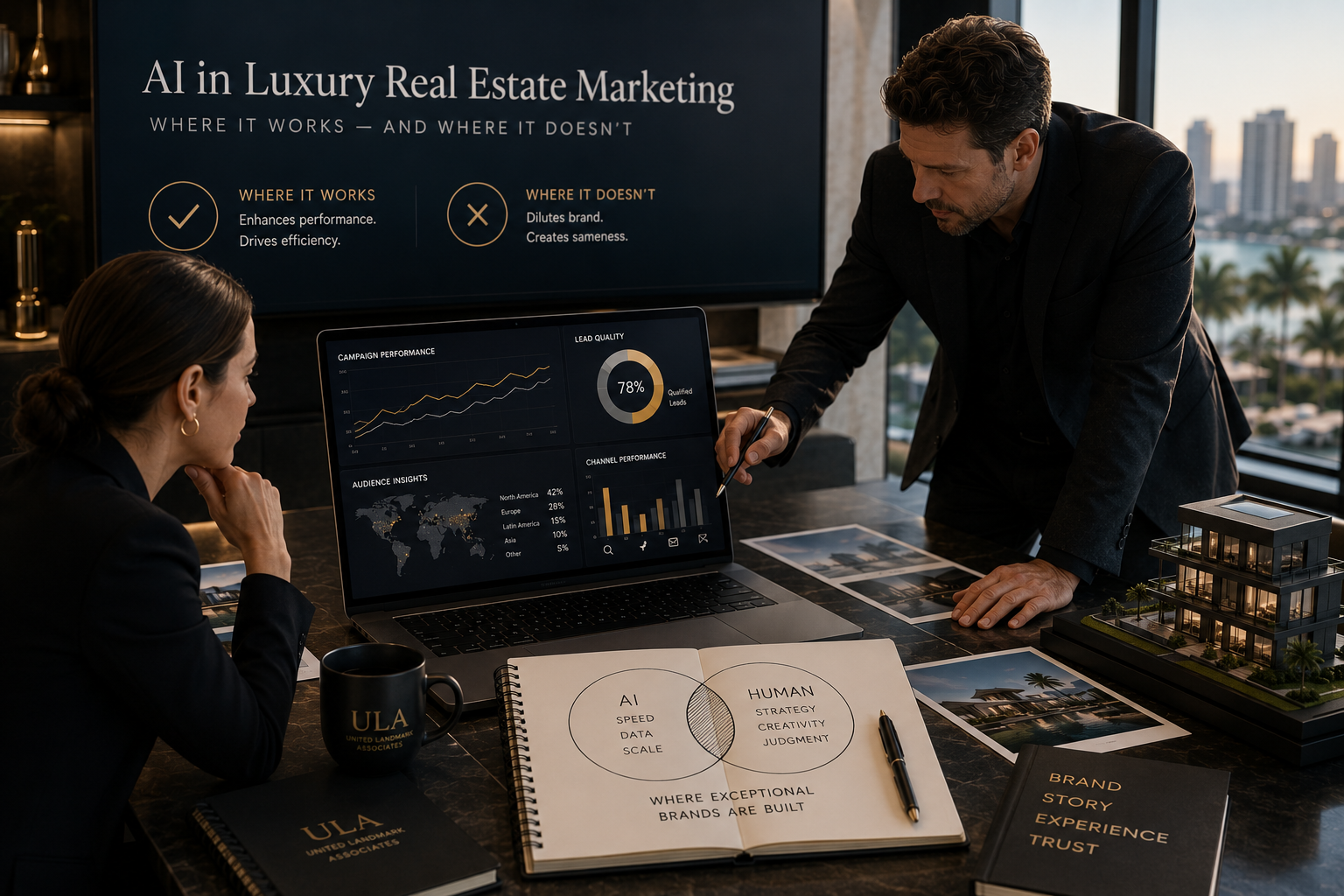
24 Apr AI in Luxury Real Estate Marketing: Where It Works — and Where It Doesn’t
Artificial intelligence is becoming part of nearly every marketing conversation right now. Agencies talk about AI-generated campaigns, AI-powered targeting, AI-driven optimization, and automated content production as if more technology automatically creates better marketing.
In some areas, it absolutely helps.
But luxury real estate operates differently than most industries. High-end branding depends heavily on perception, emotional positioning, consistency, and trust. Buyers are not simply evaluating a property. They are evaluating the experience surrounding it, the credibility of the brand, and whether the marketing feels aligned with the level of exclusivity being promised.
That changes how AI should be used.
At United Landmark Associates, we believe AI works best when it supports luxury marketing strategically instead of overwhelming it. The technology creates real advantages in speed, optimization, research, and production workflows. But luxury branding still depends on restraint, creative judgment, and understanding what should remain distinctly human.
AI Works Best Behind the Scenes
Some of the strongest uses of AI in luxury real estate marketing happen in areas buyers never directly see.
AI helps marketing teams analyze campaign performance faster, improve targeting efficiency, identify audience trends, optimize paid media campaigns, and scale production workflows more effectively. Those capabilities improve operational speed and allow campaigns to adapt more quickly when market conditions or buyer behavior shifts.
That matters because luxury campaigns generate enormous amounts of data across search, social media, CRM systems, websites, and advertising platforms.
AI helps teams process that information earlier and make better decisions faster. If a certain audience segment starts converting more efficiently, campaigns can shift budget allocation quickly. If specific creative performs better, messaging can evolve earlier instead of waiting through delayed reporting cycles. According to McKinsey & Company, marketing and sales continue to rank among the business functions seeing the strongest gains from AI adoption because automation improves responsiveness and operational efficiency.
Those improvements are real.
The problem starts when companies assume AI should control the visible identity of the brand itself.
Luxury Branding Requires Restraint
Luxury marketing has always relied on restraint.
Strong luxury brands do not overwhelm buyers with excessive messaging, endless sales language, or constant attempts to maximize attention. They create confidence through clarity, consistency, presentation, and emotional control. That same principle now applies to AI usage.
Just because AI can generate endless content does not mean it should.
One of the biggest mistakes happening across the industry right now is overproduction. Companies flood their websites with AI-generated articles, repetitive social posts, generic lifestyle copy, and automated messaging because content has become easier to create. The result often feels polished at first glance but lacks identity underneath the surface.
Luxury buyers notice that quickly.
Affluent audiences are extremely sensitive to tone and presentation. If branding feels mass-produced or emotionally generic, the perceived value of the development weakens. Buyers may not consciously identify why the marketing feels off, but they recognize when a brand lacks originality or emotional depth.
That is why restraint matters.
The goal should not be producing the most AI-generated content. The goal should be using AI carefully enough that the brand experience still feels intentional, elevated, and differentiated.
Generic AI Content Creates a Serious Problem in Luxury Markets
AI-generated content is becoming easier to recognize.
Certain phrases repeat constantly across websites. Messaging structures start sounding identical. Entire industries begin using the same tone because companies rely too heavily on automation without enough creative oversight. In luxury real estate, that creates a major branding risk because differentiation is one of the most valuable parts of the marketing itself.
A luxury development should never feel interchangeable.
That is where human creative direction still matters enormously. Experienced strategists understand how to shape emotional positioning around architecture, location, lifestyle, and buyer psychology in ways AI alone cannot fully replicate. They recognize when messaging feels too broad, too generic, or disconnected from the actual identity of the project. Without that oversight, AI often pushes brands toward sameness.
You can already see signs of it happening online. Different developments across different cities begin sounding nearly identical because the underlying content structure is being generated from the same types of prompts and automation systems. The visuals may change, but the emotional experience starts blending together. That weakens luxury branding over time.
AI Supports Luxury Marketing. It Shouldn’t Replace It.
The strongest luxury marketing teams are not rejecting AI. They are using it selectively and strategically. AI improves production speed, optimization, testing, reporting, audience segmentation, and operational efficiency. It helps teams move faster behind the scenes and allows campaigns to become more adaptive over time. Those advantages matter, especially in digital marketing environments where responsiveness directly affects performance.
But luxury branding still depends heavily on emotional intelligence and human judgment.
As Scott Galloway recently said, “Brands are built on emotion, not efficiency.” That idea becomes even more important in high-end real estate because buyers are often purchasing identity and aspiration as much as the physical property itself.
Technology can support that process. It cannot fully replace the people shaping the perception behind the brand.
The Future of Luxury Marketing Will Be More Selective With AI
Over the next several years, AI will become increasingly common across real estate marketing. Content production will accelerate. Campaign automation will improve. Advertising platforms will rely even more heavily on machine learning and predictive optimization systems.
That part is inevitable.
What will separate strong luxury brands from forgettable ones is how intentionally the technology gets used. The firms that stand out will not necessarily be the loudest about AI. They will be the ones using it thoughtfully while still protecting the emotional quality and creative integrity of the brand experience.
At United Landmark Associates, we believe AI works best when it strengthens strategy and execution without overpowering the identity of the development itself. Luxury marketing still depends on storytelling, positioning, emotional connection, and understanding how affluent buyers perceive value. Those fundamentals have not changed. Because in luxury real estate marketing, technology matters. But perception matters more.
FAQ
How is AI used in luxury real estate marketing?
AI helps marketing teams improve targeting, campaign optimization, audience segmentation, reporting, and production workflows while increasing operational efficiency.
Why does luxury branding require restraint with AI?
Luxury branding depends heavily on emotional perception, exclusivity, and consistency. Overusing AI-generated content can weaken differentiation and make branding feel generic.
What are the risks of generic AI content in luxury markets?
Generic AI content often creates repetitive messaging and interchangeable branding that reduces originality and weakens buyer trust in premium markets.
Can AI replace luxury real estate branding agencies?
No. AI supports marketing execution, but luxury branding still depends on strategic positioning, storytelling, creative direction, and human insight.
Where does AI work best in real estate marketing?
AI works best in data analysis, audience targeting, campaign optimization, testing, reporting, and repetitive production tasks.
How does ULA approach AI in luxury marketing?
ULA uses AI strategically to improve speed and efficiency while maintaining strong human oversight across branding, storytelling, positioning, and creative direction.