


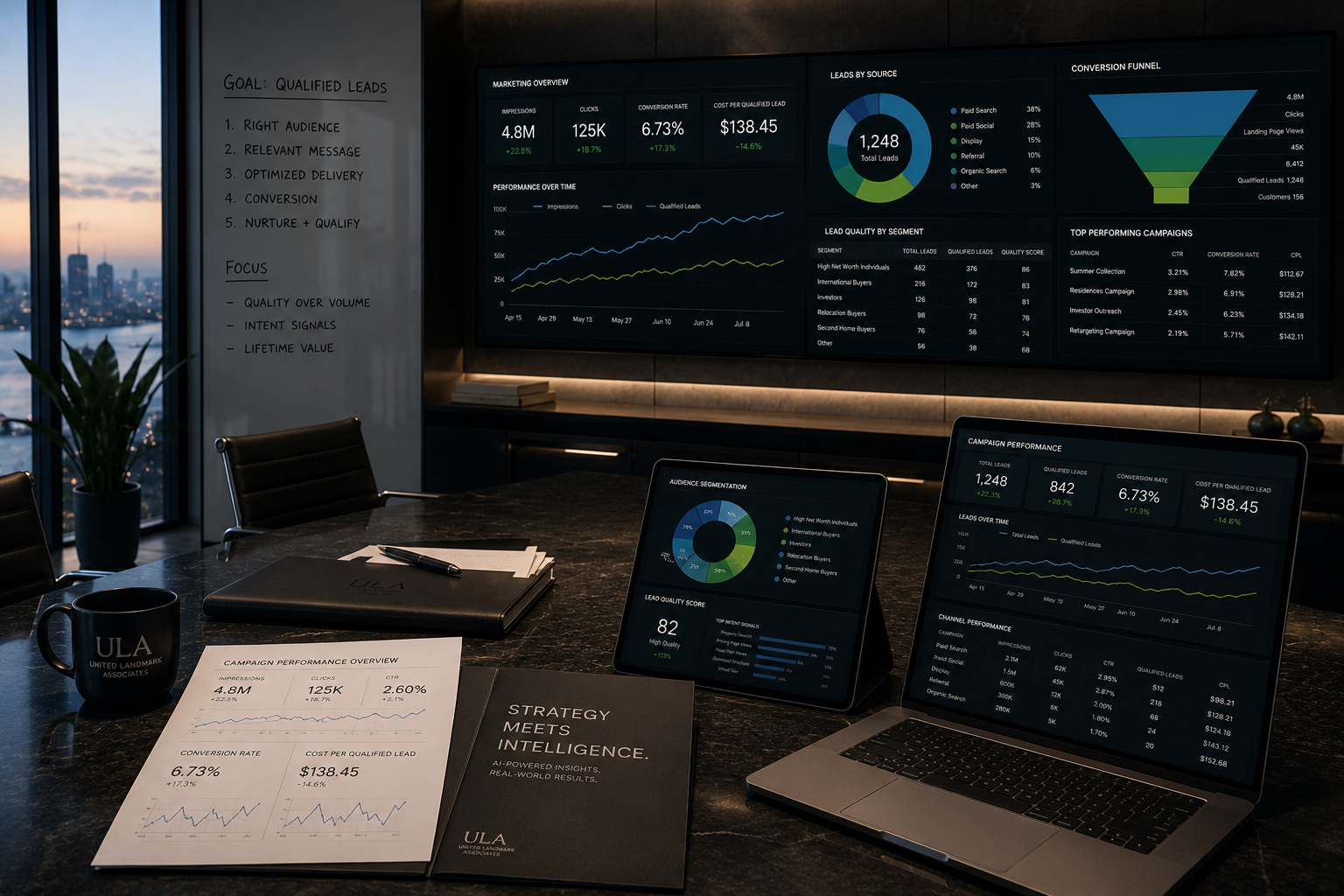
18 Apr Using AI to Drive Qualified Leads, Not Just More Content
One of the biggest misconceptions around AI marketing is that more content automatically means better results. Many companies have started producing larger volumes of ads, emails, blogs, and social content simply because AI makes production easier and faster.
But volume alone does not solve the real problem most developers care about.
They want qualified leads.
In luxury real estate marketing, impressions and traffic only matter if they lead to the right audience. A campaign generating thousands of clicks means very little if those visitors are not financially aligned with the product, location, or lifestyle being marketed. Developers are not looking for more activity. They are looking for stronger buyer intent, better conversion quality, and more efficient marketing performance.
At United Landmark Associates, we see AI as a tool that helps improve marketing precision, not just marketing output. The strongest use of AI today is not flooding the internet with more content. It is helping teams identify the right audiences, optimize campaigns faster, and improve lead quality over time.
AI Helps Marketing Teams Find Better Audiences
Audience targeting has become significantly more complex over the last several years. Consumer behavior changes quickly, platform algorithms evolve constantly, and luxury buyers now move across multiple digital channels before ever submitting an inquiry.
AI helps marketing teams process that behavior more efficiently.
Modern advertising platforms already use AI heavily behind the scenes. Systems inside Google Ads, Meta, LinkedIn, and other platforms continuously analyze user behavior, engagement patterns, search intent, device usage, and conversion activity to improve campaign delivery. That allows campaigns to adjust dynamically instead of relying entirely on static targeting rules.
For luxury real estate campaigns, that matters because affluent buyers rarely behave like mass-market consumers.
Their search behavior is different. Their engagement patterns are different. Their decision-making timelines are longer and often more research-driven. AI helps marketers identify those patterns earlier so campaigns can focus more budget toward audiences showing stronger purchase intent instead of simply maximizing reach.
According to McKinsey & Company, companies using advanced personalization and AI-driven targeting strategies consistently outperform competitors in lead generation and conversion efficiency. The advantage comes from precision, not just scale.
Better Segmentation Leads to Better Conversion Quality
One of the most valuable uses of AI in marketing is audience segmentation.
Luxury real estate buyers are not one large audience group. A second-home buyer searching for a waterfront residence behaves very differently from an investor evaluating a branded tower in an urban market. Empty nesters relocating from the Northeast respond differently than younger international buyers focused on lifestyle amenities and long-term value.
AI helps marketing teams separate those audiences more effectively.
Instead of delivering the same messaging to everyone, campaigns can adapt based on user behavior, interests, engagement history, and search patterns. Different audiences can receive different creative, different landing pages, different calls to action, and different messaging angles depending on where they are in the buying journey.
That level of segmentation improves conversion quality because the marketing becomes more relevant to the person seeing it.
Without segmentation, campaigns often become too broad. The messaging loses focus, lead quality drops, and developers end up spending money attracting users who were never likely to convert in the first place.
AI Improves Campaign Optimization in Real Time
Traditional marketing campaigns often relied on delayed reporting cycles. Teams would launch campaigns, wait for performance data, then make adjustments weeks later after enough information accumulated.
AI has changed that process.
Today’s platforms optimize campaigns continuously in real time. AI systems analyze engagement signals, identify stronger-performing creative, adjust delivery patterns, and shift budget allocation automatically as performance data changes. Marketing teams can now react much earlier when campaigns underperform or when certain audience segments begin converting more efficiently.
That responsiveness improves lead generation performance significantly over time.
According to Salesforce Research, marketers using AI-powered optimization tools report stronger personalization capabilities, faster campaign adjustments, and improved operational efficiency across digital advertising channels.
But optimization still requires human oversight.
AI can identify performance trends, but experienced marketing teams still determine whether those trends align with broader brand and business goals. A campaign generating cheaper leads is not necessarily producing better leads. In luxury real estate, lead quality matters more than raw volume.
More Content Does Not Automatically Create More Leads
This is where many companies misunderstand AI completely.
Because AI makes content production easier, some marketing teams assume the answer is simply creating more blogs, more ads, more emails, and more social posts. In reality, excess content without strategic direction often creates noise instead of results.
Buyers already see enormous amounts of marketing every day. Adding more content does not automatically increase trust or engagement. In some cases, it weakens brand perception if the messaging feels repetitive, generic, or disconnected from the identity of the development itself.
That is especially true in luxury real estate.
Affluent buyers respond to confidence, consistency, presentation, and credibility. The quality of the marketing experience matters just as much as the quantity of impressions being generated. AI helps campaigns perform better when it improves targeting, timing, messaging relevance, and optimization strategy, not when it simply increases output volume.
The Goal Is Better Marketing Precision
The most effective use of AI in luxury real estate marketing comes down to precision.
Better audience segmentation. Better campaign optimization. Better targeting decisions. Better understanding of buyer behavior. Better conversion efficiency over time.
At United Landmark Associates, we use AI to help campaigns become more adaptive and performance-driven while still maintaining strong creative direction and strategic oversight. The technology allows teams to respond faster, test more intelligently, and improve lead quality more consistently across digital channels.
But successful campaigns still depend on strategy first.
As Scott Galloway recently said, “The most valuable companies are not collecting the most data. They are making the best decisions with it.”
That idea reflects where real estate marketing is heading. AI is making campaign execution faster and smarter, but long-term success still depends on understanding how to attract the right buyers instead of simply generating more visibility.
Because for developers, impressions are not the goal.
Qualified leads are.
FAQ
How does AI improve lead generation in real estate marketing?
AI helps improve audience targeting, campaign optimization, personalization, and segmentation, which leads to higher-quality leads and better conversion efficiency.
Can AI improve luxury real estate advertising?
Yes. AI helps marketing teams identify stronger-performing audiences, optimize ad delivery, and improve campaign performance across digital platforms.
What is AI audience segmentation?
AI audience segmentation uses behavioral data, engagement signals, and user activity patterns to divide audiences into more relevant groups for targeted marketing.
Does more content automatically improve lead generation?
No. More content only helps when it supports a clear strategy. Generic or excessive content can weaken engagement and reduce marketing effectiveness.
Why does lead quality matter more than impressions?
High impression counts do not guarantee conversions. Luxury developers benefit more from reaching financially qualified buyers with genuine purchase intent.
How does ULA use AI in digital marketing?
ULA uses AI to support targeting, optimization, campaign analysis, and audience segmentation while maintaining human-led strategy and creative oversight.